Search is undergoing its biggest transformation since the introduction of featured snippets. Google’s Search Generative Experience (SGE) integrates AI-generated answers directly into the search results, reshaping how users discover information and how websites earn visibility.
Search is undergoing its biggest transformation since the introduction of featured snippets. Google’s Search Generative Experience (SGE) integrates AI-generated answers directly into the search results, reshaping how users discover information and how websites earn visibility.
For businesses, marketers, and consultants, SGE represents both a challenge and a competitive opportunity. To stay visible in an AI-driven search landscape, SEO strategies must evolve—focusing less on keyword density and more on topical depth, entity signals, and authoritative content.
This article explains what SGE is, how it changes SEO, and what you should be doing in 2025 to remain competitive.
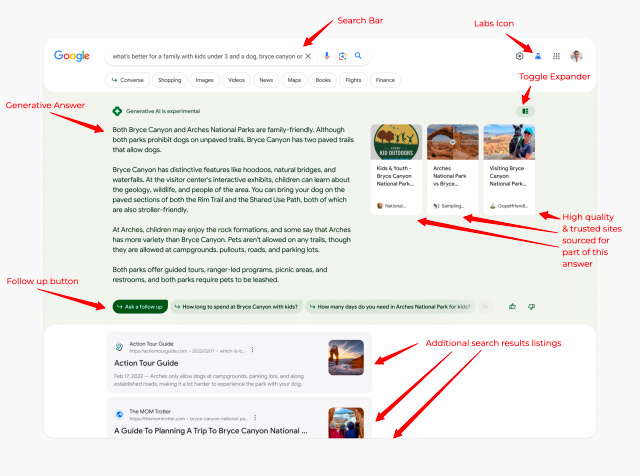
SGE is Google’s AI-generated answer summary that appears above or alongside traditional search results. Instead of displaying a list of blue links, Google provides a synthesized answer based on multiple sources.
Typical SGE output includes:
For many queries, SGE replaces the need to click into a website. This affects organic traffic patterns significantly.
When Google provides the answer upfront, fewer users scroll down to the organic results. Industries most affected include:
If a query’s main goal is “learn something quickly,” SGE shortens the journey.
SGE cites only a small set of sources—usually authoritative, entity-rich websites. You must strengthen:
Google prefers websites with clear expertise, identifiable authors, and strong topical depth.
SGE is imperfect for:
These areas will continue to rely heavily on traditional SEO.
Google needs to understand who you are to trust and feature your content. Strengthen your entity profile:
Write content that covers a topic from multiple angles—cluster-based content. For example, for “Technical SEO”, you would publish articles on:
SGE tends to cite websites with comprehensive topical ecosystems, not one-off articles.
AI summaries often miss nuance. Your advantage is expertise. Add the following:
Human insight improves authority and reduces the risk of being “summarized away.”
At minimum:
Structured data improves your chance of being referenced in SGE’s citation carousel.
SGE is not the “death of SEO”—it is the evolution of it. Businesses and consultants who adapt early will benefit from increased authority and visibility.
SEO is moving toward semantic depth, entity strength, and demonstrable expertise.